Five Generations – Appendix III
Contents
- Chapter I — Frischman or Frischmann?
- Chapter II — The First Generation — Johann and Zofia Frischman
- Chapter III — The Second Generation — The Children of Johann and Zofia
- Chapter IV — The Third Generation — The Children of Franz Frischman and Marcjanna Fuchs
- Chapter V — The Fourth Generation — The Children of August and Wanda Salomea
- Chapter VI — The Fifth Generation — The Children of Franciszek and Wanda, née Grochowicz
- Conclusion
- Appendix I — The Pharmacy Profession in the Nineteenth Century
- Appendix II — The Criminal Case of Antoni Frischmann
- Appendix III — Stanisław Adolf’s Letters from America
- Appendix IV — Karolina Baraniecka’s Letters and the Family’s Financial Affairs
- Appendix V — The Elisabeth Commemorative Cross
- Appendix VI — Karolina Baraniecka’s Children
- Appendix VII — Building the House in Dynów
- Appendix VIII — The Adoption of Franciszek Frischman-Baraniecki
- Appendix IX — Staszek Baraniecki’s Letters from Auschwitz
- Appendix X — The Family of Filip Frischman-Baraniecki
- Appendix XI — An Account of the Ukrainian Attack on Dynów, Including Our Pharmacy
- Appendix XII — Franciszek Frischman’s Professional Placements
- Appendix XIII — Kazimierz Baraniecki’s Professional Placements
- Appendix XIV — Grant of Nobility and a Coat of Arms to Georg Frischman — 3 May 1727
Stanisław Adolf’s Letters from America
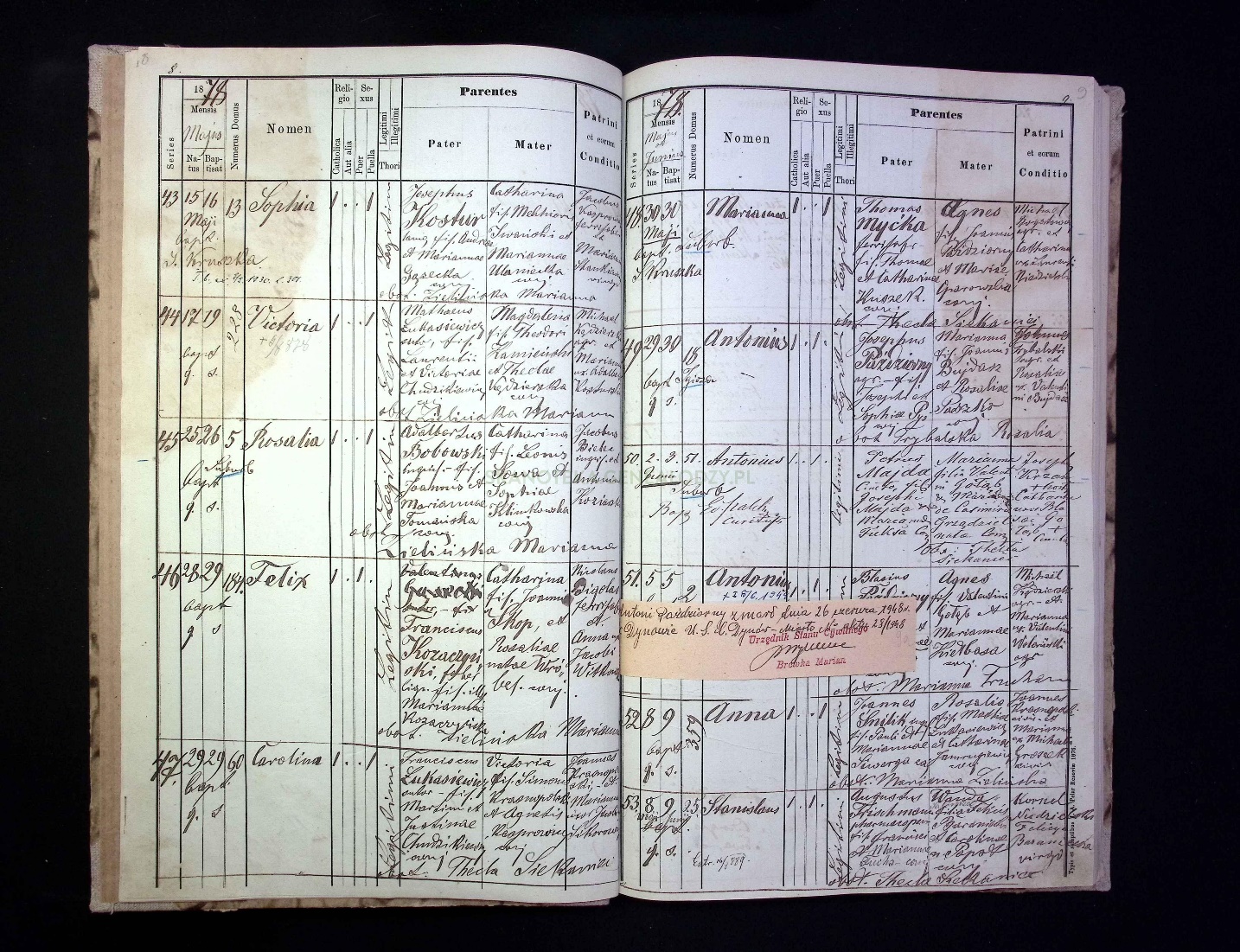
Stanisław Adolf Frischmann — the son of August and Wanda Salomea.
Born in Dynów in 1878; died in Buffalo, New York, USA, in 1930.
In our Home, little was said about him. When he was mentioned, it was with a hint of sadness or regret…
His portrait hung in the dark entrance hall, and that, too, spoke for itself.
Only fragments of recollections survive about what he did before emigrating.
He is said to have worked as a waiter at the “U Hawełki” restaurant in Kraków, and supposedly served in the Austro-Hungarian Navy in Trieste. But, to tell the truth, there is no evidence of either.
The evidence begins only with his departure for America.
In June 1902, Stanisław Adolf boarded the German steamship S.S. Patricia in Hamburg. The ship belonged to the Hamburg America Line, known as HAPAG.
His third-class ticket cost about $30, equivalent to approximately $1,100 today.
After buying it, Stanisław had $14 left in his pocket. That was the amount he declared to the American immigration authorities.
Following a ten-day voyage, S.S. Patricia reached New York on 12 June 1902.
Conditions in third class aboard the Patricia were, I would say, harsh. Passengers slept in shared quarters, with their bunks very close together.
The ship carried more than two thousand passengers. There were only a few bathrooms, with cold water or lukewarm seawater.
Fortunately, meals were included in the price of the ticket. They were simple enough: stews, cabbage and bread.
In the enormous space below deck, where hundreds of passengers slept, the stuffiness was unbearable!
Fortunately, part of the deck had been set aside for third-class passengers, who could go outside for some fresh air.
On arriving in New York, Stanisław underwent an examination. That was the procedure.
Stanisław Adolph was not tall. He was 168 centimetres in height, with blue eyes and, as the record states, brown hair.
Under distinguishing marks, the entry reads: “First joint of right ring finger missing.” This may have been a congenital condition, or the result of an injury later in life.
As I have mentioned, he declared that he had $14, equivalent to about $500 today. The bare minimum to get started.
He was twenty-four.
He also declared that he would stay with a cousin at 14 Lewis Street on the Lower East Side, but this was only a temporary address.
Later, he changed addresses quite often.
By the time of his letter dated 17 November 1903, he was living in Brooklyn.
After 9 December 1904, the letters to Dynów stopped. Great-grandmother Wanda and Grandpa Franio, together with the whole family, waited and waited. Finally, on 23 July 1905, they decided to write to the Austro-Hungarian Consulate General in New York.
A reply arrived on 8 September 1905, stating that Stanislaus Frischmann lived at 199 East 4th Street in New York.
That was not true. The Consulate had given Grandpa an old address which was no longer current. It had not done so maliciously, but the fact remains that no official had been sent there to check whether Stanisław Adolf actually lived at that address. Instead, the Consulate had supplied an address from its old records of 1902.
Stanisław, who by then was already using the name Adolph or Stanley, was living elsewhere.
He remained in New York until 23 May 1908, when he went to Niagara in Ontario, Canada, for two weeks. There he worked for some Jewish women, presumably as a cook.
He was not happy, however, and returned to America, settling in Buffalo, where things began to go a little better for him.
In 1909, at an exhibition in Buffalo, he won two first prizes and one second prize for his dishes.
Feeling a little more confident, he went to Virginia, where he found work as head chef at a hotel. There, his employer’s wife fell in love with him and urged him to take her to Dynów.
“I’ll take $1,000 out of the bank and we’ll go. You can tell your mother we’re married,” she said.
Nothing came of it. As he wrote to his mother, he could never have lied to her and claimed that the woman he had brought home was his wife.
He must have had some money by then, because he offered to buy tickets for Mother, Wandzia and Kazio to come to Hamburg or Fiume on the Adriatic, simply so that they could see one another. He missed them so much.
Nothing came of that either.
Several times, he was robbed of everything. As he wrote, he was left “without a penny to his name”.
Meanwhile, in accordance with the deed under which he had received the pharmacy, his brother Franciszek was completing the payments due to his siblings.
Stanisław’s share was 7,000 crowns, and Grandpa deposited that sum in a savings account.
Stanisław knew nothing about it, although such a sum would have been an enormous help to him at the time.
Contact with Dynów grew increasingly infrequent.
Then came the Great Depression of 1929, which Americans still recall with horror in their eyes. Those were terrible years! The opportunities for work dwindled to nothing.
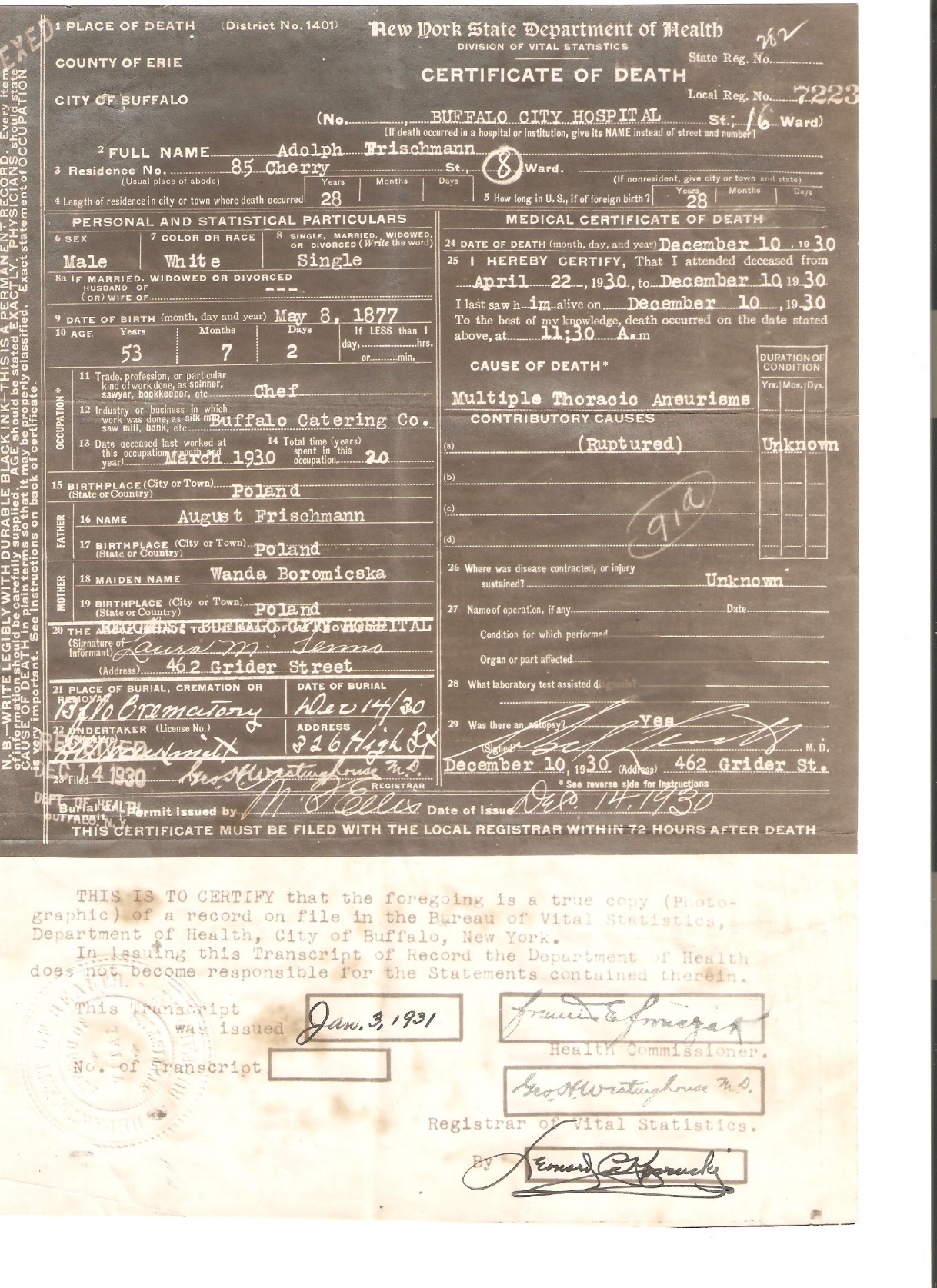
Stanisław Adolf Frischmann died suddenly from ruptured aneurysms of the thoracic aorta.
It was 10 December 1930, at 11:30 in the morning, in Buffalo.
News of his death must have reached Dynów quite quickly, because in January 1931 Grandpa’s lawyer, Stanisław Sosnowski, wrote to the Consulate of the Republic of Poland in Buffalo to enquire about any estate the deceased might have left.
The reply arrived on 9 February 1931. I include it here.
And that is probably all. Many matters remain unexplained. Perhaps one day someone will find the determination to investigate them thoroughly. For now, however, we must make do with what we have.
Letters from Stanisław Adolf Frischmann have survived.
They are remarkable precisely because they do not describe great historical events.
They describe the ordinary life of an emigrant.
Around 1930, while the whole world writhed and groaned under the burden of the Great Depression, and bodies falling from New York skyscrapers discouraged anyone from going for a walk, Grandpa Franio’s family was doing exceptionally well.
A little earlier, news had arrived from America about Stanisław Adolf Frischmann.
It came from Jakub Wyszatycki, a former resident of Dynów with whom Grandpa Franio was on good terms. Wyszatycki’s entire family had emigrated to America before the First World War.
After the war, Jakub went to visit them and brought back a great deal of news, including news of Staszek.
The last message came through a German named Schwarz, who passed on Staszek’s request for financial help, as he was destitute. Sadly, before arrangements could be made, Stanisław died. It was December 1930.
Here are the letters he sent to Dynów over more than twenty-five years.
In chronological order.
New York, 12 January 1903
Dear Mother,
Do not worry about my not writing, Mother, because really, what am I to write when I know that you and Franz are well? I am well too, and I can say that I am a hundred times healthier and stronger than I was at home. But what good is that when I have no work?
Since I last wrote to Franio, I have done nothing. I did have a place as a cook, but you know yourself, Mother, what sort of cook I am. My employer soon discovered the same thing and told me to clear off. So I am doing nothing, and my head is spinning with thoughts of what will happen next, because I am sick of sitting about idle. I am not afraid of starving, as I have sixty-two dollars in the bank and a few more on me, so I can manage for a while yet. But I am tired of it, and I spend all day running round offices, shops and restaurants, asking whether there is any work. Always nothing.
These are such times that, without exaggerating, at least 250,000 people are out of work. Anyone is glad to work just for board and lodging, and I am beginning to think of that myself, because what else can I do? I am thinking that if I do not find work this week, I will go and become an apprentice in some bakery or something… Otherwise, I lack nothing, dear Mother. I am healthy, I have an appetite, and I sleep well. The one thing I cannot get out of my head is that until December I had some luck, and now it is nothing and nothing. Today I read an advertisement for waiters on a ship sailing to India. That would not be bad, but if you read the newspapers, Mother, perhaps you have seen how many ships are sinking and being wrecked in the storms just now, so I am not very eager to go. There are terrible storms at sea at present. But who knows whether I shall decide to go aboard, if only to scrape through until April. Afterwards, there is enough to be earned to make up for the whole winter.
I have already decided that I will not touch those sixty-two dollars in the bank, even if I have to sell the boots off my feet. And the worst of it is that no job here is secure. Today I work, and tomorrow I may not, even if I am the most honest man alive. Just imagine, Mother, a country where so many rogues and all sorts of people live, and when you apply for a position, the employer asks for no papers or anything. Think for yourself: if some wanderer came to Dynów without any papers, would you take him on?
But things are different here. They cannot be described, and no one would believe it.
A few days ago, I read that an engineer was wanted. Only someone who knew how to cut meat should apply. Would not an engineer in Galicia laugh at that? [The word order in the original seems confused — my note.] Or an intelligent man is wanted to keep an old gentleman company: forty dollars a month, with board and lodging. People rush there, and the man doing the hiring says the position costs ten dollars. You pay the ten dollars and get the job, but the old gentleman throws you out after two days. Then he and the man who hired you share the ten dollars. Such thieving goes on here, and this whole America is nothing but humbug. Everyone cheats and steals as best he can.
And you keep thinking, Mother, that gold lies in the streets here. If I had a trade, that would be something. But since I am nothing here, I too cheat as best I can, because what am I to do?
I would give you my address, Mother, but I do not know where I shall be tomorrow. As soon as I find some work, I shall write to you at once and send you the address.
I kiss your hands, Mother, and send Franio a warm kiss.
My respects to everyone.
Your loving and grateful son,
Stanisław
Here are two more letters from Stanisław Frischmann to his mother, Wanda Salomea Frischmann, née Baraniecka, the widow of August.
Brooklyn, 17 November 1903
Dearest Mother!
On your name day, I wish you all the very best, and above all good health.
I wrote to you at the end of August, dearest Mother, and so far I have had no reply. I left the place where I was working in the summer, as it was only a summer job. For the past three weeks, I have been working somewhere else. I am doing well enough in the sense that at least I am healthy, but I work like a horse, from five in the morning sometimes until eleven at night. I even work on Sundays.
Is the house finished yet? Is Franio well? Please write soon, dearest Mother, and tell me what is happening at home, whether you are well, and what is happening with my brother-in-law. Are Dusia and Zosia well, and what is Zosia’s address in Przemyśl? What is happening with Filip? He has not written to me yet. He seems to be angry with me.
I have nothing to write to you about, dearest Mother, because I know nothing of what is happening at home. I cannot even remember when I last received a letter from you. Once again, I wish you all the very best, and may God grant you many more years of health and happiness.
I kiss your hands, dearest Mother, and send warm kisses to Franio and Dusia.
Your grateful and loving son,
Stanislaus Frischmann
c/o Mr Ch. Lutz
Harrison Ave No. 185
Brooklyn N.J.
America
My respects to all our friends.
The next letter is dated 14 March 1910 and comes from Buffalo. I retain the original spelling, although in places I correct obvious errors.
Buffalo, 14 March 1910
Dearest Mother!
I wish you all the very best for the approaching Easter holidays, and above all good health. I have not written for a long time, but what am I to write when things are always the same with me? I had been thinking of coming home, but I put the idea out of my head. Such thoughts always come to me when I grow tired of this chasing after luck, but it is always the same story.
Since New Year, I have worked only a few weeks in all. Now I am supposed to get another position in a few days, but not in Buffalo. Once again, I am waiting, and so it always goes.
When I start working this time, I shall stay in one place for a few months, then go to California. At least I shall see a little of the world and have a few different adventures along the way.
On 12 March, I came back from Niagara Falls. I had been there for a whole week, working for Jewish women from Hungary. But I grew tired of being under their rule, packed my things, and now I am back in Buffalo.
Dearest Mother, if I were a novelist, I could write several volumes about my time in America. Even so, I never lose hope that I shall come home, though only for a visit, and then set off wandering again. I shall never make a fortune — or perhaps I shall one day; I do not know yet. But I manage somehow, even though things often go badly. I never complain, because complaining would do me no good.
What is happening at home? Write and tell me something about Dynów, dearest Mother. I kiss your hands countless times.
Your grateful and loving son,
Stanisław
On the reverse is a short letter to Grandpa Franio and Grandma Wandzia:
Dear Franio and Wandzia!
I wish you a happy Easter and everything you wish for yourselves. I am not thinking about Easter, because I do not know where I shall be.
What is happening, and how are you getting on? Write and tell me something. I was ill for a few weeks, but somehow I pulled through. Otherwise, there is nothing new with me. What is happening with Filip? I have not written to him, but if he writes to me, I shall reply. How are things with Banach? Do you write to one another? How is your family? Is it growing? In truth, I do not even know how many children you have. Tell me something about yourself. Write back soon.
Kisses to you, Wandzia and the children.
Your truly loving brother,
St.
Address:
Adolph Frischmann
c/o Sam Kirchmann
130 Broadway
Buffalo, N.Y.
The next letter from Stanisław Adolf Frischman in America is undated. I think it was written after the Pharmacy was transferred to Franciszek, which took place in 1911. This letter, like all the others, is poignant. Stanisław writes that he would like at least to “have a few proper meals”… I leave it without comment, because the letters speak for themselves.
Dear Francio and Wandzia!
My dear Franeczek, I hardly know how to answer your last letter. In any case, thank you for remembering me. But, dear Franeczek, when I think about it — for surely it is high time I had a little sense — the honest truth is that I would cry if I came home and tried to make something of myself with money that you and Mother had worked so hard for. I too had the chance to put something aside. Since I have done nothing for myself, it is not my habit to blame anyone else. I only think: Staszek, this is your maxima culpa.
Somehow, dear Franeczek, I am ashamed to accept your offer. I would be ashamed before Wandzia and little Kazio of having been so foolish, because I had the chance to get somewhere and did not. What is done is done. Besides, I do not complain that I have had no luck, or have none now. Somehow, I always…
[The next sheet is missing.]
…Black people. I remembered those little monthly booklets, with pictures of Black people on their covers, and myself as a little boy at home. That was so many years ago, and how quickly they have passed. Dearest Mother, what did Henryk Niewolkiewicz do? Write and tell me what happened to him. Tell me how Zosia and Dusia are. They must be quite grown up by now. Give me their addresses, so that I can at least send them a card.
Tell me something about Dynów, so that I know something, because here I know nothing, except that I have seen a good part of the world.
How is Grandma Przychodzka?
I am glad, dearest Mother, that everyone at home is well. I lack nothing either, but sometimes I think how good it would be to spend even a week at home and have a few proper meals.
Write to me soon, dearest Mother. I kiss your hands countless times.
Your always grateful and loving son,
Stanisław
Here are further letters from Stanisław:
Pittsburg, 15 December 1910
Dearest Mother,
For Christmas and the New Year, please accept my sincerest wishes for every happiness. I am still in Pittsburg and shall not leave until after New Year. I do not know where I shall go, but there is such poverty here that no one would believe it. I do not even write to tell you what I am doing, because it makes my insides turn over. I have no luck, or whatever it is — I do not know. Since leaving New York, I have been chasing about the world, but I am tired of that too. On 30 June, I left Detroit for Buffalo, and that very day I got a position paying twenty dollars a week. I was to leave the next day. I packed my things and went to bed. When I woke up, everything had been stolen. I had nothing but what I was wearing in bed. Photographs, papers, belongings — everything stolen. I informed the police and brought in a detective. It was as though it had all vanished into thin air.
I could not take any position, because how could I go anywhere when I had been left with nothing?
I borrowed some clothes and got a position on the fastest train in the world, running from Chicago to New York. In New York, I had left a trunk when I went away, with a gold watch, a diamond pin and another with an opal. I thought I would pawn those things and get myself straightened out somehow. I went there, and what did I find? Two years earlier, the trunk had been broken into and the things stolen. I had not written to anyone there and knew nothing about it.
Now, once again, in Pittsburg, I had a fair amount of money, and on 8 November my work ended. I was paid, and I thought I would leave on the ninth, which was a Wednesday, for New York or Chicago. In the best of spirits, I went to bed. When I woke in the morning, I had not a penny to my name. Everything had been stolen. And whom was I to look for? Enough to say that…
The letter breaks off here.
Clarksburg, W.Va., 27 February 1911
Dearest Mother!
I received your last letter, and to tell you the truth, dearest Mother, it brought tears to my eyes. I seem to have a soft heart, and not a day goes by without my thinking of home. But I do not know what to make of it all. I had every intention of going to New York, and once there, getting home would have been the least of my worries. I had arranged everything properly, but things turned out differently. I am in Virginia, a long way from Pittsburg. I boarded the train at eight in the morning and did not arrive until half past eleven at night. I am the chef at a hotel. All the kitchen workers are Black, and I have the title of chef. I have never written to tell you how I came by it. Two years ago, at an exhibition in Buffalo, I entered three pieces and won two first prizes and one second prize. Sometimes I laugh to myself at how I came to be a cook.
Dearest Mother, now I shall turn to something else: your last letter, in which you ask whether I have gone astray. I do not know what to write about that. But I do know that I love you terribly, and I would come home, only somehow I am afraid of you. The best proof is that when my employer’s wife wanted to take a thousand dollars out of the bank and run away with me to Dynów, asking me to lie to you and say she was my wife, I felt quite foolish. I thought: how could I lie to you? I was afraid of you, dearest Mother. But this autumn I must see you. I shall come to Hamburg or Fiume (?) — I do not mind where — and send you the money for the journey, and you will come with Wandzia and Kazio. You know, dearest Mother, however well a person may be doing abroad, something still draws him home.
You would never believe, dearest Mother, what came into my mind when I arrived here, where I am now, and saw in the kitchen…
This interesting letter ends there. The next, and the last one I have — the last that has survived — seems to have been written to Aunt Fela.
Buffalo, 16 January 1927
Dear Aunt!
I received your letter and the photograph of Filip. In your last letter, you ask how I celebrate Christmas. Since I received that letter on 22 December, Christmas had not yet begun. Now that Christmas and New Year are over, I have a good subject to write about. On Wednesday, I very nearly had no work, and on Thursday it was the same. Friday was Christmas Eve. Since I had not celebrated Christmas for so many years, I ate nothing all day, and I do not remember ever eating meat on that day. After all, even in America one can be a decent person and fast twice a year, on Christmas Eve and Good Friday.
Saturday, 25 December, was the great feast day. I looked at the photographs of Franio, Filip and the whole Family, kissed you all, and said a prayer for everyone. That was in the morning. In the evening, I found work, and by the time I came home it was Sunday morning. At four, I went to bed and thought about your last letter, asking how I celebrate Christmas.
On Sunday evening, I went out and met an old German friend. After we talked, he gave me six days’ work. I received seven dollars for each day, making forty-two. After paying my various expenses and the rent, I had twelve dollars left. What I did over those six days is difficult to describe. Enough to say that on New Year’s Eve we had three hundred people for dinner, and on New Year’s Day there was a cold buffet for 997 people. Everything that had taken the three of us six days to prepare was gone in two and a half hours.
Since New Year until today, 16 January, I have had no work.
Dear Aunt, you want to know whether I have travelled around America. Yes, I have travelled quite a lot and seen all sorts of things, but the most beautiful are the Falls…
At this point, the letter breaks off again.
These are all the letters I have from Stanisław Frischman.
Stanisław never married.
He had no children.